
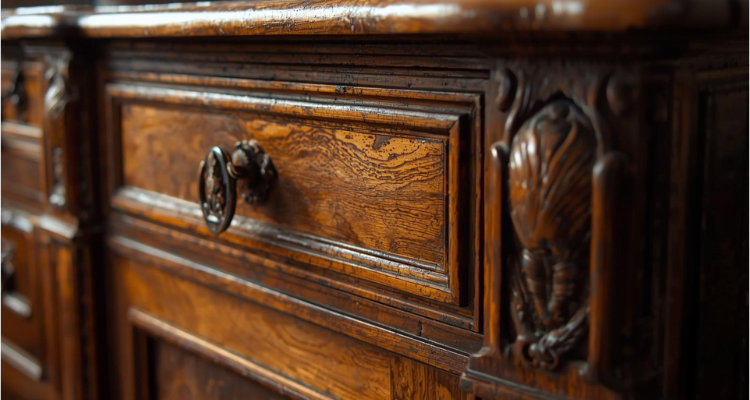
There is a reason antique oak furniture can stop you in your tracks. Good old oak furniture does not simply get darker with age; it develops depth, softness, warmth and a surface quality that feels almost alive. What collectors call patina is really the visible record of chemistry, craftsmanship, environment and human use all working together over decades, and often centuries. In oak, that process is especially attractive because the timber is naturally rich in tannins and other extractives, and because it responds to light, air, polish and touch in a way that tends to produce mellow browns, golden undertones and beautifully worn high points rather than flat, lifeless ageing.
Oak also has deep roots in British furniture history, which helps explain why so much antique oak furniture survives in the first place. Historic England notes that oak was historically the timber of choice until the second half of the 18th century, and its dendrochronology guidance describes oak as the major structural timber in many areas. Forest Research has likewise described oak as the most important broadleaved tree species grown in Britain in terms of area and production. In other words, oak was not a niche material: it was central to Britain’s built and domestic history, which is why old oak furniture remains such an important part of the antiques trade today.
One of the biggest reasons oak ages so well is oxidation. As oak is exposed to oxygen over time, chemical changes take place in its lignin and extractives, gradually shifting the colour and character of the surface. Peer-reviewed work on European oak has shown that ageing in the living tree itself is associated with darkening and with the polymerisation of ellagitannins, a key class of oak tannins. Another study found that oak heartwood usually darkens during and after drying, and linked this to the behaviour of hydrolysed tannins and ellagic acid within the wood structure. That matters visually because oak’s colour is not just a superficial stain sitting on top of the grain; it is tied to genuine material changes within the timber.
Those tannins are a huge part of the story. Oak wood contains polyphenolic compounds, especially ellagitannins, and literature notes that these compounds are associated with antioxidant effects and are among the defining chemical components of oak. Another article states that ellagitannins may represent up to 10% of oak heartwood. In practical terms, that helps explain why antique oak furniture often develops such complex colour. Tannins can absorb UV, react with oxygen, and gradually change the way the timber reflects light. Rather than ageing into something dull, oak often ages into something richer.
Light exposure is another major driver of patina. Scientific work on oak has shown that the greatest colour changes can happen surprisingly early in exposure, with one study finding that around 50% of the total colour change in oak occurred within the first 20 hours of UV irradiation, and around 85% of the lightness change happened in that same early period. The same research linked oak’s yellowing to lignin photodegradation and noted that ultraviolet radiation degrades extractives and drives quick oxidation of the degradation products. Another study comparing oak under ultraviolet and visible light found more pronounced discolouration under UV, with overall colour change values of ΔE* 5.9 under ultraviolet exposure versus 4.0 under visible light. That helps explain why antique oak furniture placed in bright rooms often mellows so attractively, especially on exposed tops, drawer fronts and door panels.
Yet oak does not just react to light; it responds to being lived with. The arms of a chair, the edge of a table, the lip of a drawer and the top rail of a coffer all tend to polish differently from untouched areas. Museums are so aware of this that handling guidance from National Museums Scotland warns that oils, sweat and dirt on hands can damage varnished or waxed wooden surfaces, while the National Trust likewise states that gloves help protect historic furniture from the oils on our hands. In everyday antique terms, that means centuries of use can subtly compress, smooth and burnish the surface in handled areas. Not every mark is desirable, of course, but gentle repeated contact combined with waxing and careful housekeeping is part of what gives old oak furniture its softness and visual depth.
This is where the phrase “patina” becomes more useful than simply saying “wear.” Wear can mean damage. Patina is different. A good patina is balanced. It leaves the grain readable, the surface varied and the colour layered. On antique oak furniture, you often see this as a gentle contrast between slightly darkened recesses and warmer, smoother high spots. That effect comes from several processes happening together: oxidation inside the wood, the changing chemistry of tannins, the action of daylight over long periods, and the gradual polishing effect of wax, dusting and human touch. The best surfaces look calm rather than shiny, rich rather than glossy, and honest rather than over-restored.
It is also worth remembering that oak’s beauty is bound up with age on a larger scale. Forest Research notes that pedunculate and sessile oak are Britain’s two native oak species, and a 2021 Research Note states that native oak across Great Britain supports 2,300 species, with 326 obligate species depending on it. That ecological longevity mirrors the material longevity collectors admire in antique oak furniture. Oak is a tree associated with endurance, and that endurance carries through into furniture made from it. When properly cared for, old oak furniture does not merely survive; it continues to improve aesthetically in a way many modern materials never do.
So why does antique oak furniture age so beautifully? Because oak is chemically expressive. Its tannins react. Its colour evolves. Its surface records sunlight, oxygen, polish and use. Over time, those influences soften the harshness of the new and replace it with something more complex, more individual and more convincing. That is the science of patina, but it is also the romance of antiques: the idea that a material can become more beautiful not in spite of age, but because of it.
