
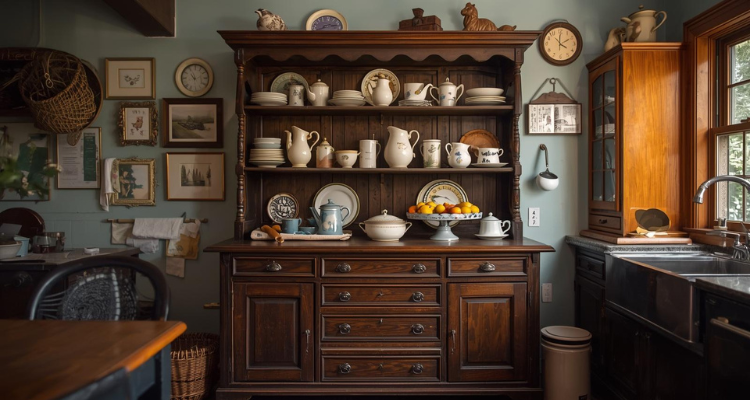
Few pieces of country furniture carry the same warmth, authority and quiet grandeur as the English oak dresser. To some, it is the image of the old farmhouse kitchen: pewter plates on the rack, Delft chargers leaning against the backboards, drawers worn smooth by generations of hands. To collectors, however, antique oak dressers are far more than attractive storage pieces. They are regional documents, pieces of social history and, at their best, masterpieces of vernacular craftsmanship.
An oak dresser does something few antiques manage. It can dominate a room without feeling formal. It has presence, but not pretension. It was built for daily use, yet the best examples now sit comfortably in important collections, country houses and beautifully designed modern interiors. That is why truly exceptional old oak dressers still create competition when they appear on the market.
From Working Furniture to National Icon
The dresser’s roots reach back to the medieval “dressoir”, a high-status serving and display piece used in great halls. In France, the number of shelves on a dressoir could even reflect the owner’s rank and status. By the 17th century, however, the English dresser had become a much more domestic object, commonly found in kitchens, parlours and dining spaces, combining storage below with display above.
This is part of its appeal. The oak dresser sits between utility and display. The lower section, the oak dresser base, provided drawers, cupboards or open shelving for food, linen, utensils and household goods. The upper rack allowed ceramics, pewter, copper and later blue-and-white china to be displayed. Before built-in kitchen units, the dresser was one of the most important pieces of storage furniture in the home.
Unlike fashionable town furniture, dressers were often made by local craftsmen using local timber and local habits of construction. This gave them enormous regional variety. A London cabinetmaker might follow pattern books and fashionable tastes. A country joiner might follow what his father, neighbour or county had always done, but with small differences that now matter enormously to collectors.
Why Oak?
Oak was the great timber of English country furniture. It was strong, available, practical and visually beautiful. Antique Collecting (https://antique-collecting.co.uk/2016/03/29/guide-to-english-oak/) notes that English oak has a fine, close grain and hardens with age, while medullary rays – the pale, shimmering flecks seen particularly in quarter-cut oak – are one of the timber’s most recognisable features.
This is why colour matters so much. A good oak dresser is not simply “brown”. It may have honey, nut-brown, russet, tobacco, chestnut, golden or almost black tones, depending on its age, surface, wax, light exposure and use. The finest examples have what dealers often call “skin”: a deep, mellow, untouched surface that cannot be recreated quickly or convincingly.
Collectors will often forgive old repairs, historic wear and signs of use. In fact, they expect them. What they are far less forgiving of is stripped, sanded, aggressively restored or heavily altered oak. A dresser should look as though it has lived, not as though it has been made to look old.
Regional Variations: Why One Dresser Is Not Like Another
One of the joys of studying old oak dressers is that they were not made to one universal pattern. The phrase “Welsh dresser” is now often used generically, but not every dresser with a rack is Welsh. Homes & Antiques (https://www.homesandantiques.com/antiques/the-history-of-the-dresser) makes the important point that the term can be a broad description rather than a guarantee of origin, and that many English regions developed their own distinctive forms.
Welsh dressers are perhaps the most famous. Many have strong architectural racks, shaped friezes, potboards, cupboards, spice drawers, bold proportions and a sense of sculptural presence. North Wales examples, especially those associated with Snowdonia, can be particularly desirable. Bonhams has described a rare early 18th-century North Wales canopy dresser from Snowdonia, dating to circa 1720–50, with a deep boarded rack and wavy-cut frieze (https://www.bonhams.com/auction/19878/lot/617/a-rare-early-18th-century-oak-canopy-dresser-north-wales-circa-1720-50-snowdonia/).
Lancashire and North West dressers often have their own character too. Mahogany crossbanding, decorative inlay, multiple drawers and robust cupboard bases can appear on late 18th and early 19th-century examples. A Bonhams listing for a George III North West English oak and mahogany crossbanded dresser base (https://www.bonhams.com/auction/18730/lot/557/a-george-iii-oak-and-mahogany-crossbanded-dresser-base-north-west-english/) shows how oak could be combined with fashionable decorative contrast while remaining firmly within the country furniture tradition.
Shropshire, Cheshire, Yorkshire, West Country and border-country pieces may differ in turnings, feet, drawer arrangements, frieze shapes, rack construction and proportions. These details are rarely random. They are the furniture equivalent of accents. To an experienced eye, a shaped apron, a potboard support, a canted corner, a particular foot or a drawer configuration can suggest where a dresser was made — or at least where its maker learned his trade.
The Oak Dresser Base: The Collector’s Favourite?
While the full dresser with rack has romance and height, the oak dresser base has become especially sought after for modern living. It gives the colour, age and storage of a dresser without needing a high ceiling or large wall. As Homes & Antiques notes, dresser bases are popular because they suit a more uncluttered interior look.
A good dresser base can work as a sideboard, serving table, hallway piece or kitchen feature. Collectors look for good proportions, untouched surface, original handles or handle positions, well-shaped drawers, fielded panels, pleasing feet and a strong, honest colour. Earlier examples with depth of patina and minimal alteration tend to be the most desirable.
The best bases have balance. The drawers should sit comfortably above the cupboards or potboard. The top should have honest wear but not be ruined. The back should tell a story too. Rough boards are common, but occasionally a back is unusually well finished, which may suggest the piece once stood away from a wall.
A fascinating Christie’s example of a late 18th-century large Welsh oak dresser had a carefully made and painted back, leading to the suggestion that it may have been free-standing, possibly used as a shop counter rather than simply pushed against a wall (https://www.christies.com/en/lot/lot-4755184).
Dating Clues: What to Look For
Dating an oak dresser is rarely about one single feature. It is about reading the whole piece.
The timber is a starting point. Old oak tends to have depth, oxidation and a surface that has changed through centuries of handling and cleaning. Quarter-cut boards can show medullary figuring, while internal and back boards may reveal older methods of conversion. Antique Collecting notes that pit-sawn timber can often be identified by distinctive parallel saw marks on unfinished backs or interior boards.
Construction is equally important. Early pieces may show pegged joints, hand-cut dovetails, thick drawer sides, boarded backs, wear around handles and unevenness that comes from hand work rather than machine regularity. Later 18th and 19th-century pieces may be neater, lighter or more influenced by fashionable cabinet furniture.
Handles can help, but they can also mislead. Many old dressers have had several sets of handles over their lifetime. Look for shadow marks, plugged holes and differences in oxidation. Replacement brasses do not necessarily ruin a piece, but original or period-correct fittings are always preferable.
The rack also needs careful consideration. On many antique oak dressers, the rack and base have been “associated”; meaning they did not start life together. Christie’s, for example, describes a mid-18th-century Welsh oak dresser with an associated plate rack, three frieze drawers and a potboard.
An associated rack is not automatically a disaster, especially if the marriage is old and visually convincing. But a dresser with its original rack, original base, good colour and untouched surface will always have stronger collector appeal.
Rare Features That Make Collectors Look Twice
Certain features can lift an oak dresser from attractive to exceptional.
A potboard is one of the most loved features. This open lower shelf, often supported by turned legs or shaped supports, gives a dresser a lighter, more architectural feel. It also connects the piece directly to its working life, when pots, bowls and utensils needed to be stored within easy reach.
A canopy rack can be highly desirable, especially on Welsh and North Wales examples. These racks often have shaped sides, deep boarded construction, pendants, pierced or wavy friezes and a more enclosed, almost architectural quality.
Spice drawers are another collector favourite. Small drawers within the rack or upper section add charm, usefulness and rarity. They also remind us that spices, tea and small household luxuries were once valuable enough to deserve their own protected storage.
Other sought-after details include original paint, original scumbled decoration, dated initials, unusual drawer arrangements, fielded panel backs, canted corners, shaped bracket feet, untouched brasses, pleasing small proportions and outstanding colour.
But rarity alone is not enough. An unusual dresser that has been stripped, cut down or heavily rebuilt may be less desirable than a simpler example with superb colour and integrity.
What Makes an Exceptional Oak Dresser?
An exceptional oak dresser usually has five things: age, originality, colour, proportion and presence.
Age matters, but it is not everything. A plain early 19th-century dresser with wonderful untouched colour may be more appealing than an earlier example that has been over-restored. That said, 17th and early 18th-century dressers with strong originality remain especially prized. Homes & Antiques notes that value depends heavily on age and originality, with 17th-century dressers retaining particular strength, while 18th-century examples often sit in a different price band from later 19th-century dressers.
Originality matters because dressers were working objects. Tops were replaced, racks were added, feet were reduced, backs were altered, handles were changed and cupboards were adapted. Some changes are historic and acceptable; others damage the character of the piece.
Colour is often the deciding factor. Collectors will talk about it endlessly because it is one of the hardest qualities to fake. The surface should have depth and variation. Corners, handles, drawer edges and cupboard doors should show wear where hands naturally touched them.
Proportion is what makes a dresser beautiful from across the room. A great dresser has rhythm: the rack, shelves, drawers, cupboards, legs and feet all seem to belong together. It should feel settled and architectural, not awkward or top-heavy.
Presence is harder to define, but easy to recognise. It is the quality that makes someone stop when they walk into a room. The best antique oak dressers have it in abundance.
Why Collectors Still Fight Over Them
The oak dresser remains desirable because it offers something increasingly rare: authenticity. It was not made as a decorative reproduction of rural life. It was rural life. It held plates, food, linen, pots, pans, candles, tea, pewter and family possessions. It was part of the daily rhythm of the home.
Today, that history gives antique oak dressers their power. They are practical, beautiful and deeply atmospheric. They work in cottages, farmhouses, Georgian homes, converted barns and contemporary interiors. They can be dressed with ceramics or left almost bare. A good oak dresser base can anchor a room. A full dresser with rack can define one.
For collectors, the chase is part of the pleasure. Finding an old oak dresser with the right colour, the right proportions, the right surface and the right regional character is not easy. Exceptional examples do not appear every day, and when they do, they are rarely overlooked.
That is why the oak dresser remains one of England’s most iconic pieces of furniture. It is not just a storage piece. It is a record of craft, place, use and time, and when the right one comes along, collectors know exactly why it is worth fighting for.
