
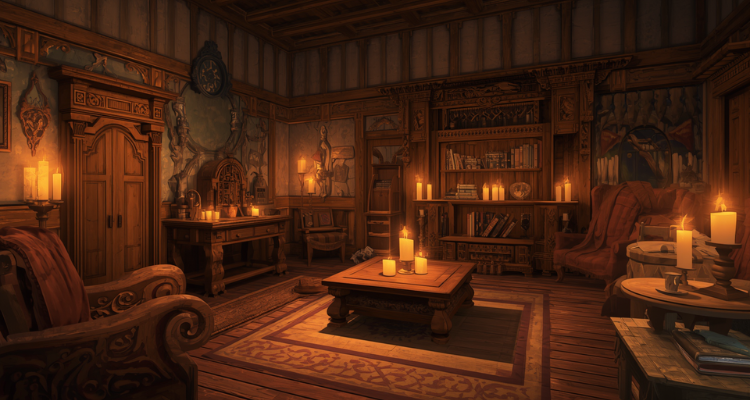
Think Tolkien, Game of Thrones and the Great Halls of Legend
Picture a great hall in a fantasy kingdom.
There is almost certainly a roaring fire, a stone floor, iron candleholders and a vast wooden table scarred by generations of feasts, arguments and political plotting. High-backed chairs stand beneath carved shields, while heavy chests line walls darkened by age.
Whether the scene belongs in Tolkien’s Middle-earth, the castles of Westeros or a modern fantasy role-playing game, the visual language feels instantly familiar. Much of that atmosphere owes a considerable debt to the real interiors, craftsmanship and antique oak furniture of medieval, Tudor and later Gothic Revival Britain.
The connection is not quite as simple as J.R.R. Tolkien seeing an oak chest and immediately inventing Middle-earth. Instead, historic oak furniture helped to create our shared idea of what an ancient European world should look and feel like. Fantasy authors, illustrators, filmmakers and production designers have inherited that visual vocabulary, and continue to use it today.
Why Does Oak Feel So Perfect for Fantasy?
Oak has qualities that make it particularly effective in imagined historical worlds. It appears strong, permanent and rooted in the landscape. Its grain, knots, marks and changing surface suggest that an object has already lived through decades, or perhaps centuries, of human activity.
A sleek modern table might suit a futuristic spaceship, but it is unlikely to convince us that kings have negotiated treaties around it or that warriors once celebrated a victory there. A substantial oak refectory table, panelled coffer or carved chair already seems to contain a story.
Historic British interiors reinforced this association. The National Trust identifies dark oak panelling, trestle tables, benches, heavy chests and carved four-poster beds as characteristic features of Tudor design. These were often accompanied by tapestries, heraldic decoration, stone fireplaces and rich fabrics. The same combination frequently used to establish castles and noble households in fantasy fiction: https://www.nationaltrust.org.uk/discover/history/architecture/interior-design-through-the-ages
Oak also carries a sense of hierarchy. A simple bench suggests communal life, while an imposing carved chair immediately indicates status. A large table can become the centre of an entire household, council or kingdom. Furniture therefore does more than fill the background of a fantasy scene: it quietly tells us who holds power.
The Great Hall: Where Fantasy Stories Begin
Many fantasy worlds revolve around the great hall.
It is where rulers receive visitors, families gather, disputes are settled and strangers arrive with troubling news. The great hall can be a dining room, courtroom, council chamber and ceremonial space all at once.
Historically, furniture in such rooms was often practical rather than plentiful. Long tables, benches, stools, cupboards and chests could be moved or rearranged according to the occasion. This relative simplicity helped individual pieces carry greater significance.
A chair was not merely somewhere to sit. It could be a symbol of authority. A chest might protect clothing, documents, money or valuable household goods. A long table physically arranged people according to rank, placing the household’s most important figures in the most prominent positions.
Fantasy writers have repeatedly returned to this idea because it creates drama without needing lengthy explanation. Place one character in a carved oak chair at the head of a table and another on a plain bench near the door, and the audience immediately understands their relative standing.
Tolkien, Rohan and the Anglo-Saxon Hall
J.R.R. Tolkien’s fascination with the medieval world was far deeper than a taste for castles and swords. He spent almost 40 years teaching subjects including Old and Middle English, Old Norse and Gothic at the universities of Leeds and Oxford. His professional knowledge of ancient languages, myths and heroic literature became one of the foundations of Middle-earth.
The Tolkien Estate provides an overview of his academic work and his deep engagement with texts including the Old English poem Beowulf: https://www.tolkienestate.com/
The influence is particularly visible in Rohan. An Oxford lecture on Tolkien’s medieval languages explains that he drew upon the Old English of Mercia when developing the culture and language of the Riders of Rohan: https://writersinspire.podcasts.ox.ac.uk/content/old-english-tree-tongues-tolkiens-medieval-languages
This helps explain why Rohan feels so convincingly Anglo-Saxon. Its culture is built around horses, loyalty, kinship, spoken history and the authority of the hall. Meduseld, the Golden Hall of King Théoden, is not simply an impressive building. It is the centre of political, domestic and ceremonial life.
Although Tolkien did not provide readers with an antique dealer’s inventory of every chair and coffer inside Meduseld, the atmosphere belongs to the tradition of northern European halls furnished with long tables, benches, carved seating, chests and practical wooden objects.
The furniture does not need to be described in exhaustive detail because readers already recognise the world it represents. Generations of historic interiors, museum displays, illustrations and surviving antique oak furniture have taught us how such a place ought to look.
Furniture as Evidence of a Lost History
One of Tolkien’s greatest strengths was his ability to make Middle-earth feel as though it had existed long before the reader arrived. Ruins have forgotten names. Swords possess histories. Songs refer to half-remembered events. Objects pass between generations.
Antique furniture creates a similar effect in the real world.
The softened edge of a table, the wear around a lock, old repairs and variations in colour reveal that a piece has been used rather than merely displayed. These signs of age encourage the imagination to supply missing stories.
Who owned the chest? What did it contain? How many meals were served on the table? Was the carved chair reserved for the head of the household?
This is why genuine antiques have such power in film, theatre and interior design. Even when a viewer cannot identify the exact period or construction method, an old piece often feels more convincing than something that has been artificially distressed for a production.
It brings its own evidence.
How Game of Thrones Made Fantasy Feel Real
The television adaptation of Game of Thrones used furniture, architecture, materials and texture to make its enormous fictional world believable.
Production designer Deborah Riley explained that each kingdom needed its own distinctive visual identity. When the differences between those environments worked, the audience accepted the various regions as real places. At Castle Black, for example, real timbers and a working forge contributed to the physical credibility of the setting.
The Royal Television Society’s account of Riley’s work can be read here: https://rts.org.uk/article/game-thrones-production-designer-deborah-riley-bringing-westeros-life
Throughout the northern parts of Westeros, rough timber, heavy tables, benches, chests, iron fittings and undecorated wooden surfaces reinforce ideas of hardship, duty and survival. In wealthier locations, furniture becomes more elaborate and ceremonial, helping to communicate political ambition and social rank.
Interestingly, the production did not rely solely on medieval European references. Riley drew from many periods and cultures. Architectural Digest reports that Frank Lloyd Wright’s textile-block houses influenced the design of Meereen Palace, demonstrating how production designers combine genuine historical references with unexpected sources to create something new: https://www.architecturaldigest.com/story/frank-lloyd-wright-inspired-this-game-of-thrones-set
This is an important part of successful fantasy design. The world must feel familiar enough to be believable but original enough to remain mysterious. Historic oak furniture performs the same function. We recognise its construction, purpose and material, but its age leaves room for imagination.
The Gothic Revival: A Bridge Between History and Fantasy
Modern ideas about “medieval” interiors were also shaped by the Gothic Revival of the 18th and 19th centuries.
Rather than simply preserving the past, Gothic Revival designers reinterpreted it. Pointed arches, tracery, shields, quatrefoils, carved foliage and cathedral-like forms were transferred from architecture onto chairs, tables, bookcases and cabinets.
The Metropolitan Museum of Art explains how Gothic Revival furniture applied the forms of medieval buildings to domestic objects. Tables might be supported by forms resembling flying buttresses, while chairs and bookcases incorporated lancet arches, tracery and heraldic shields: https://www.metmuseum.org/about-the-met/collection-areas/the-american-wing/period-rooms/gothic-revival-library
These interiors helped establish the romantic image of the old castle filled with carved furniture, armour, tapestries and mysterious family history.
At Speke Hall, the National Trust records how a 19th-century restoration introduced exuberantly carved oak furniture, stained glass, suits of armour and tapestries to create fashionable Gothic Revival interiors: https://www.nationaltrust.org.uk/visit/liverpool-lancashire/speke-hall/history-of-speke-hall
Oxburgh Hall offers another revealing example. Its owners reused panelling, ancient textiles and heavy oak furniture alongside heraldic motifs and neo-Gothic decoration to produce what the National Trust describes as a romantic atmosphere: https://www.nationaltrust.org.uk/visit/norfolk/oxburgh-estate/visit-the-hall-at-oxburgh
In many ways, the Gothic Revival was creating fantasy interiors before fantasy became a major literary and cinematic genre.
From the Great Hall to the Modern Home
Most people are not attempting to recreate Winterfell in the dining room—and central heating is generally preferable to relying on a single smoky fireplace.
Nevertheless, individual pieces of antique oak furniture can bring some of the same depth and atmosphere into a modern home without making it feel like a film set.
An oak coffer can serve as storage, a coffee table or a striking feature beneath a window. A refectory-style table can become the natural gathering point of a kitchen or dining room. A carved cupboard introduces architectural interest, while a small joint stool or side table can add character without dominating the space.
The key is contrast. Antique oak can look particularly effective against restrained colours, contemporary artwork and simple modern lighting. Instead of recreating an entire historic room, one well-chosen piece becomes the object around which the rest of the interior develops.
The result is not theatrical. It is layered.
Why Genuine Antique Oak Still Captures the Imagination
Modern fantasy reminds us that furniture can be more than decoration. It can represent inheritance, authority, hospitality, conflict and continuity.
A table gathers people together. A chest protects what is valuable. A chair establishes rank. A cupboard displays wealth and craftsmanship. These functions have remained recognisable for centuries, which is why historic oak pieces feel equally at home in a Tudor manor, a fantasy castle or a thoughtfully designed contemporary interior.
When browsing antique oak furniture for sale, collectors are therefore looking at more than useful household objects. They are encountering pieces connected to the same traditions of craftsmanship, symbolism and storytelling that helped shape some of the world’s most convincing imaginary realms.
Tolkien gave us halls where songs preserved the deeds of kings. Game of Thrones gave us council chambers where the future of kingdoms could turn on a single conversation. Behind both stands a much older idea: that the furniture surrounding us helps explain who we are, where we came from and what we hope to leave behind.
At Peter Bunting Antiques, our selection of antique oak furniture for sale offers the opportunity to bring that sense of history into your own home. Preferably without the dragons, battles or unexpected claims to the throne.
