
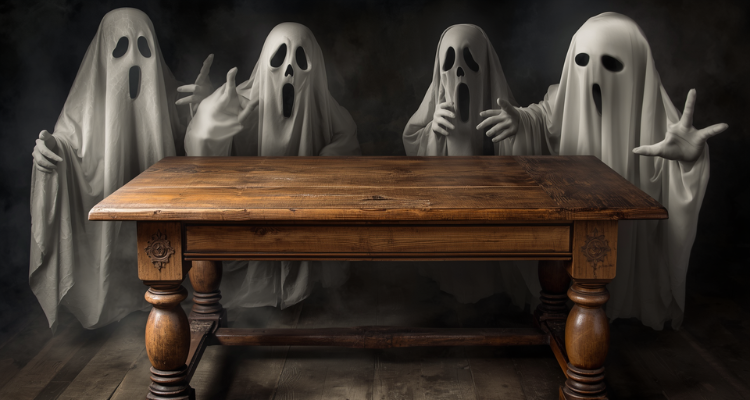
There is something about old oak that invites stories.
Perhaps it is the colour: that deep, almost blackened surface created by centuries of smoke, polish, candlelight and human touch. Perhaps it is the weight of it: a solid oak table, coffer or chair can feel less like a piece of furniture and more like a permanent resident of the house. Or perhaps it is simply that antique oak furniture has lasted long enough to gather not only scratches and repairs, but whispers.
Britain’s oldest oak furniture was made for real life: eating, sleeping, praying, storing, marrying, mourning and surviving. It stood beside hearths, under low beams, in manor houses, farmhouses, inns and churches. It saw births, deaths, secrets, illnesses, arguments and inheritances. Small wonder, then, that some pieces became tied to darker legends.
Not every “cursed” chair or haunted table can be proved, of course. Many stories have grown in the telling. But what is certain is that early households did believe in unseen dangers. Evil spirits, witchcraft, fire, illness and bad luck were not just the stuff of fireside tales; they were part of everyday fear. And sometimes those fears were carved directly into the oak.
Why Oak Became the Wood of Memory
Oak has always held a special place in British life. English oak, or Quercus robur, is one of Britain’s most iconic native trees. The Woodland Trust notes that oak supports more life than any other native tree species in the UK, and that oak trees can live for over 1,000 years. Once they reach around 400 years old, they are classed as ancient trees. Source: https://www.woodlandtrust.org.uk/trees-woods-and-wildlife/british-trees/oak-tree-wildlife/
That longevity is one reason oak furniture carries such emotional force. The tree may already have been centuries old before it was felled. Then, once shaped into a table, chest, chair or cupboard, it could survive for another three or four hundred years inside a home.
For collectors, this is part of the appeal of antique oak furniture. A 17th century oak coffer or plank table is not simply “old”. It may be older than the house it now stands in. It may have outlived monarchs, wars, plagues, changing fashions and entire family lines.
BADA, the British Antique Dealers’ Association, describes the traditional medieval English coffer as usually being constructed from native oak, valued for its strength and durability. Source: https://www.bada.org/features/terms-trade-coffer/
This is why an antique oak furniture dealer will often talk about surface, patina and construction with such care. These details are not just aesthetic. They are evidence. Tool marks, pegged joints, ironwork, carved panels, wear patterns and colour can all help tell the story of how a piece was made and used.
But sometimes, the most intriguing marks are not purely practical.
Witch Marks: When Furniture Was Built to Keep Evil Away
One of the strangest truths about historic British houses is that many were deliberately marked to keep evil out.
These marks are often called “witch marks”, though Historic England explains that they are more accurately known as apotropaic marks: symbols intended to turn away evil. Common examples include daisy wheels, hexafoils, overlapping Vs, mesh patterns and other repeated lines. Source: https://historicengland.org.uk/whats-new/features/discovering-witches-marks/what-are-witches-marks/
The National Trust notes that these markings were often placed near windows, doors and fireplaces, because these were considered vulnerable entry points for demons, witches and harmful spirits. Importantly for furniture lovers, the Trust also states that witch marks can be found not only on buildings, but also on furniture, gravestones and caves. Source: https://www.nationaltrust.org.uk/discover/history/warding-off-evil-with-witch-marks
This changes the way we look at antique oak furniture. A scratch on a beam, panel or chest may not be random damage. A repeated carved symbol may not be casual decoration. In some cases, it could be a deliberate act of protection.
Imagine a 17th century oak table in a low-ceilinged room. The fire is burning. The door is bolted. Outside, darkness presses against the leaded windows. Inside, the table is the centre of everything: food, family, prayer, accounts, arguments, remedies and gossip. If a household feared unseen forces, why would they not mark the timber closest to daily life?
It is easy to smile at such superstition now, but in the early modern period these fears were serious. The UK Parliament website explains that a Witchcraft Act was passed in 1604 during the reign of James I, who had a keen interest in demonology. Earlier Acts in 1562 and 1604 moved witchcraft trials from church courts to ordinary courts. Source: https://www.parliament.uk/about/living-heritage/transformingsociety/private-lives/religion/overview/witchcraft/
The world that produced much of Britain’s early oak furniture was also a world where witchcraft was a legal, religious and social fear.
Knole: Oak Beams, Gunpowder and Protection Marks for a King
One of the most fascinating examples comes from Knole in Kent, now cared for by the National Trust.
During conservation work, a series of witch marks was discovered in the Upper King’s Room, a room prepared for a planned visit by King James I. According to the National Trust, the marks were dated by tree-ring dating to early 1606, just months after the failed Gunpowder Plot of November 1605. They were found on beams and joists below floorboards and on fireplace surrounds. Source: https://www.nationaltrust.org.uk/visit/kent/knole/witchmarks-at-knole-and-the-gunpowder-plot
That date matters. The Gunpowder Plot had shaken the country. James I was already associated with witchcraft fears, and public anxiety was high. The idea that craftsmen may have carved protective marks into oak to guard a royal visitor is extraordinary.
The king never actually visited. But the marks remained hidden for centuries.
For anyone interested in antique oak furniture, Knole is a reminder that old timber often carries meaning beyond craftsmanship. Carved oak was not only decorative. It could be political, religious, protective and deeply personal.
Gainsborough Old Hall: Curse Inscriptions and 100 Burn Marks
If Knole gives us protection marks, Gainsborough Old Hall in Lincolnshire gives us something darker still: actual curse inscriptions.
In 2024, English Heritage announced the discovery of previously unidentified witch marks and rare curse inscriptions at Gainsborough Old Hall. Around 20 ritual protection marks were recorded, alongside approximately 100 burn marks once believed to protect against fire. Most strikingly, English Heritage reported that one inscription contained the name of William Hickman written upside down. Defacing or inverting a name was widely believed to curse the person named. Source: https://www.english-heritage.org.uk/about/search-news/new-research-reveals-previously-undiscovered-witches-marks-at-gainsborough-old-hall/
This is where folklore and physical evidence meet. We are not simply dealing with later ghost stories attached to an old house. We are looking at marks made by real people who believed that carving, burning or inverting symbols could influence danger, luck and fate.
For collectors of antique oak furniture, such discoveries are thrilling because they help us understand the mindset of the age. A 16th or 17th century oak piece was made in a world where material objects could be asked to do more than serve a function. A chest could protect possessions. A mark could protect a room. A table could become a witness.
The Busby Stoop Chair: Britain’s Most Infamous Cursed Seat
No discussion of cursed British furniture would be complete without the Busby Stoop Chair.
The story belongs to North Yorkshire. Thirsk Museum describes the Busby Stoop Chair as one of its most intriguing artefacts, linked to Thomas Busby, who was executed in 1702 after a dispute involving murder. According to the legend, Busby cursed the chair, and the object later gained a reputation as the “Dead Man’s Chair”. Source: https://thirskmuseum.org/displays.html
The tale has been repeated in many versions. In one, Busby sat in the chair before his execution and declared that anyone who sat in it would die. Later stories connected the chair with a series of misfortunes and deaths, especially when it was kept at the Busby Stoop Inn. Eventually, the chair was removed from ordinary use.
What makes the Busby Stoop Chair so compelling is not whether every claimed death can be verified. It is the way a plain wooden object became a container for fear. A chair is intimate furniture. We trust chairs without thinking. We turn our backs to them, lower ourselves into them, rest our weight on them. A cursed chair reverses that trust.
The Busby legend also shows how furniture can become famous for reasons far beyond quality, age or design. In the antiques world, provenance is powerful. But folklore is powerful too. A good antique oak furniture dealer will always separate romance from fact, yet the romance is often what first draws people in.
The Great Bed of Ware: Not Cursed, But Definitely Not Ordinary
Some old oak furniture is not cursed, but still carries a strange and theatrical reputation.
The Great Bed of Ware, now in the Victoria and Albert Museum, is one of Britain’s most famous pieces of furniture. Built around 1590, it was probably made as a tourist attraction for an inn in Ware, Hertfordshire. The V&A records its remarkable size: 267cm high, 326cm wide and 338cm deep. It was reputedly large enough to accommodate at least four couples. Source: https://www.vam.ac.uk/articles/great-bed-of-ware
The bed became famous very quickly. It was mentioned by Shakespeare in Twelfth Night in 1601 and later by Ben Jonson in 1609. Guests carved initials and applied red wax seals to the posts and headboard, leaving their own marks behind. The V&A also notes that the bed was originally brightly coloured, with traces of paint still visible.
The Great Bed of Ware is a wonderful example of how oak furniture could become legend in its own lifetime. It was part furniture, part spectacle, part marketing device and part social dare. It reminds us that old furniture was not always treated with solemn reverence. People carved into it. Laughed around it. Boasted about it. Told stories about it.
A 16th century oak bed or table might look sober today, darkened by age and museum lighting. In its own time, it may have been bright, noisy, public and full of scandal.
Coffers, Dower Chests and the Fear of What Lies Inside
The oak chest, or coffer, has its own darker atmosphere.
In practical terms, the coffer was one of the most important pieces of early household furniture. It stored linen, clothing, documents, money, food, tools and valuables. Some had internal tills or small compartments. Some were bound with iron. Some were carved with initials, dates or symbols. A National Trust collection example from Tintinhull House is described as an oak dower chest dating from 1625–1650. Source: https://www.nationaltrustcollections.org.uk/object/1138062
The phrase “dower chest” immediately gives the object a human story. These were associated with marriage, inheritance and domestic status. They could hold a bride’s linen, a family’s wealth, legal papers or cherished possessions. In a world without modern banks, safes and wardrobes, a chest was not just storage. It was security.
It is also easy to see why chests became linked with secrecy. A locked oak coffer invites questions. What is inside? Who owns the key? What was hidden there and never retrieved? In folklore and fiction, old chests become natural homes for letters, bones, curses, wills, jewels and family scandals.
The real antique trade is more grounded than that, of course. When looking at antique oak furniture for sale, a buyer should be more interested in originality, construction, condition, colour and surface than in dramatic legends. But the atmosphere of the coffer remains. It is a box from the past, and boxes always suggest secrets.
Concealed Shoes, Hidden Objects and Household Protection
The fear of evil entering the home did not stop with carved marks.
Historic buildings sometimes reveal concealed shoes hidden in walls, chimneys, floors or roof spaces. Northampton Museums, which keeps a Concealed Shoe Index, explains that concealed shoes were deliberately hidden in buildings and have long been a source of fascination. Source: https://www.northamptonmuseums.com/collection/collections-home/shoe/
The Museum of English Rural Life has also written about children’s shoes found in a 15th century farmhouse at Leigh-on-Sea, Essex, thought to have been deliberately deposited as an apotropaic device to protect the home. Source: https://merl.reading.ac.uk/news-and-views/concealed-folk-english-superstition/
This matters because it gives context to antique oak furniture and interiors. The same households that carved protective marks into woodwork might also hide shoes, bottles or other objects in the fabric of the building. To modern eyes, a farmhouse room might seem charmingly rustic. To its original occupants, it may have been a carefully defended space.
The oak table, the coffer, the settle and the cupboard all belonged to this world.
Why Dark Legends Still Fascinate Collectors
So why do these stories still matter?
Partly because they make furniture human. Dates and construction methods are important, but legends remind us that furniture was lived with. An oak table was not made to be displayed under perfect lighting. It was made to be used. It absorbed the rhythm of a household.
A chair might have been pulled close to the fire by generations of owners. A coffer might have travelled with a bride. A court cupboard might have displayed pewter for status. A table might have been the place where a will was signed, a quarrel began or a family gathered after a funeral.
When people search for antique oak furniture for sale, they are often looking for more than decoration. They are looking for atmosphere, authenticity and a connection to the past. That is why genuine old oak still has such appeal in modern interiors. It brings age into a room without feeling fragile. It is solid, useful and full of character.
The best pieces do not need invented ghost stories. Their surfaces already speak.
A Dealer’s View: Story Is Wonderful, But Evidence Matters
As tempting as dark legends can be, it is important to approach them carefully.
A genuine antique oak furniture dealer will always be cautious about claims of curses, hauntings or royal ownership unless there is strong evidence. Stories can add interest, but they should not replace proper assessment.
When considering early oak, look for the things that can be examined:
- The depth and consistency of colour.
- The wear in places where hands, feet and objects naturally touched.
- The construction methods, including pegged joints, panel backs, plank tops and drawer linings.
- The quality and age of carving.
- The relationship between old repairs and later alterations.
- The honesty of the surface.
A piece does not need to be cursed to be captivating. In fact, the most powerful antique oak furniture is often compelling precisely because it is real. It has survived not through myth, but through use.
The Oak Table as Witness
The “curse of the oak table” may not be one single legend. It is something broader and perhaps more interesting.
It is the feeling that old oak has seen too much.
It has stood in rooms where people feared witches, carved symbols for protection, hid shoes in walls, locked away dowries, slept in famous beds, whispered about cursed chairs and marked their presence with knives, wax, smoke and polish.
Britain’s oldest furniture is not dark because it is evil. It is dark because it comes from a world where life was uncertain, death was close, fire was dangerous, illness was mysterious and the supernatural felt entirely possible.
That is what makes antique oak so fascinating. It is furniture with depth. Furniture with scars. Furniture with a long memory.
And perhaps that is the real reason we still love it.
Not because we believe every curse.
But because, when you run your hand across a centuries-old oak surface, it is very easy to believe that the past has not quite finished speaking.
Looking for Antique Oak Furniture?
Peter Bunting Antiques specialises in antique oak furniture with age, character and genuine period appeal. Whether you are searching for a coffer, table, cupboard, dresser base or another piece of early oak, buying from an experienced antique oak furniture dealer helps ensure you choose a piece for the right reasons: quality, authenticity, condition and timeless charm.
Explore our current antique oak furniture for sale and discover pieces with real history, rich patina and stories of their own.
