
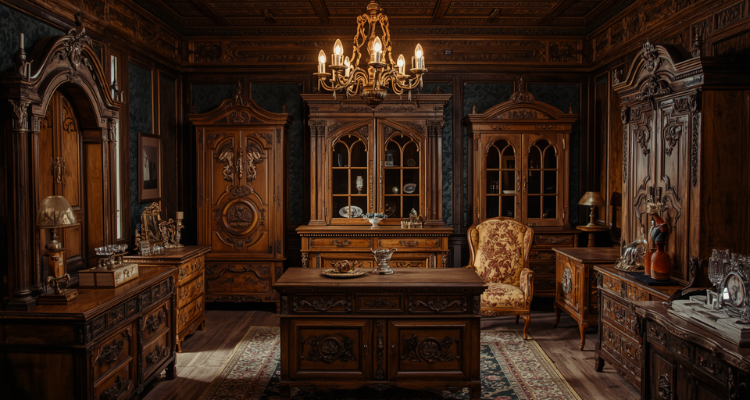
There is something wonderfully persuasive about antique oak furniture. The dark, mellow colour. The uneven surface. The carved panels. The heavy construction. The sense that it has survived fires, fashions, house moves, damp cottages, polished parlours and several centuries of family life.
But here is the awkward truth: not every piece described as “17th century oak” is actually 17th century.
Some pieces are entirely genuine. Some are later but still excellent antiques. Some are Victorian interpretations of earlier styles. Some are Georgian or 19th-century revivals. Some are made from a mixture of old and later timber. And some have simply been given a more exciting date than the evidence can support.
For anyone buying antique oak furniture, this matters. A 17th-century coffer, court cupboard or refectory table is not just “old furniture”. It belongs to a specific period of English domestic history. Its construction, proportions, carving, surface, timber and wear should all tell a consistent story. When they do not, the date deserves questioning.
Peter Bunting Antiques specialises in 16th, 17th and 18th-century country oak furniture, including refectory tables, court cupboards, coffers, dressers, settles and related pieces, with over 30 years of experience in the trade. This article explains the most common ways antique oak furniture is misattributed, and how to look at a piece with a more careful eye.
First, What Does “17th Century” Actually Mean?
The 17th century means the years 1601 to 1700. In English furniture terms, this covers a fascinating period: late Elizabethan influence, Jacobean furniture, Cromwellian simplicity, Restoration taste and the later 17th-century move towards more refined forms.
It was a period when oak was widely used in English furniture. Chests, coffers, court cupboards, joint stools, settles and refectory tables were practical, robust and often locally made. Regional character mattered. A carved chest from Yorkshire may not look quite like one from Devon or Lancashire. Joiners worked with local traditions, local timber and local customers.
A genuine 17th-century oak piece should usually show a convincing combination of age, construction, surface and design. It should not simply look “dark and rustic”.
That is where many mistakes begin.
Myth 1: “It’s Oak, Therefore It Must Be 17th Century”
Oak was used for centuries. That alone proves very little.
A piece can be oak and still be Georgian, Victorian, Edwardian or even later. In fact, oak enjoyed several revivals, particularly when later generations developed a taste for “Old English” interiors. In the Victorian period, which ran through Queen Victoria’s reign from 1837 to 1901, Britain saw huge interest in historic styles, craftsmanship, medievalism and domestic display.
That means a Victorian oak sideboard with heavy carving, bulbous legs and a dark finish may look impressively ancient at first glance. But it may be more a 19th-century romantic idea of the 17th century than a true 17th-century object.
The key point is this: oak is the material, not the date.
A good antique oak furniture dealer will look beyond the timber and ask more precise questions. How is it joined? Are the boards hand-sawn or machine-sawn? Do the mouldings match the claimed period? Are the handles, hinges, locks and feet consistent? Is the patina natural, or has it been helped along?
Myth 2: “Heavy Carving Means Earlier Furniture”
Carving is one of the great pleasures of early oak furniture, but it is also one of the easiest things to misunderstand.
Seventeenth-century carving often has rhythm, restraint and regional character. You may see lunettes, lozenges, guilloche patterns, arcading, floral motifs, initials, dates or geometric panels. A Christie’s example of a late 17th-century English oak chest, for instance, is described with a lunette carved frieze, a triple-panel front, lozenge decoration and stile feet. These are the kinds of details that help place a piece within a period and tradition.
Later copies, however, often exaggerate the carving. Victorian revival furniture can be wonderfully decorative, but it sometimes turns the volume up too high. The carving may be deeper, busier, more theatrical or too regular. Instead of feeling like part of the structure, it can feel applied for effect.
One useful question is: does the carving belong to the piece, or is it performing age?
Original carving should sit naturally within the rails, stiles and panels. It should relate to the construction. Later carving, recutting or enhancement can look sharper, cleaner or oddly fresh compared with the surrounding surface.
Myth 3: “A Date Carved on the Front Must Be the Date of the Piece”
Carved dates are attractive. They also need caution.
A chest carved “1672” may indeed be from 1672. Or the date may commemorate a marriage. Or it may have been added later. Or the panel bearing the date may be old but inserted into a later piece. Or the whole object may have been made later to look earlier.
This is especially important with oak coffers, court cupboards and panelled furniture, because individual panels have often moved around over the centuries. A 17th-century carved panel can be incorporated into an 18th or 19th-century structure. In that case, it is not entirely wrong to say the piece contains 17th-century timber, but it would be misleading to describe the whole item as a 17th-century coffer if the structure is later.
The most honest descriptions tend to be specific. For example:
“17th-century panel incorporated into a later oak coffer.”
“18th-century oak chest with earlier carved elements.”
“19th-century oak cupboard in the 17th-century taste.”
These distinctions may sound subtle, but they make a significant difference to value, rarity and collectability.
Myth 4: “Victorian Copies Are Worthless”
This is another misconception.
Victorian oak furniture is not automatically poor quality. Some 19th-century pieces are superbly made, attractive, useful and highly decorative. The issue is not whether Victorian furniture is “good” or “bad”. The issue is whether it is being sold as something it is not.
A Victorian interpretation of Jacobean style can be a handsome antique in its own right. It may suit a period home beautifully. It may have excellent colour and craftsmanship. But it should not be priced, described or understood as a genuine 17th-century piece.
The word “antique” itself can add confusion. There is no single universally accepted definition, although many people use “over 100 years old” as the general measure. The important legal and trading point is that descriptions must not be misleading.
So a Victorian oak cupboard can be antique. It just is not 17th century.
Myth 5: “Georgian Revival Pieces Are Easy to Spot”
Not always.
During the Georgian period and later, earlier oak furniture was adapted, altered and revived. Furniture did not sit untouched in museum-like conditions. It was repaired, cut down, raised up, widened, narrowed, re-polished, re-hinged and repurposed.
A coffer might become a seat. A cupboard might gain later shelves. A table might receive a new top. Feet may be replaced because they rotted from standing on damp floors. Handles and locks may change with taste and use.
This is why condition and originality are not the same thing. A piece can be genuinely old but altered. Equally, a piece can be later but made using old timber.
For collectors of antique oak furniture, the question is not always “Is every inch untouched?” That is rarely realistic. The better question is: are the alterations understandable, sympathetic and clearly explained?
Myth 6: “Dark Colour Means Great Age”
Colour is important, but it can mislead.
Early oak often develops a wonderful surface over time: deep brown, honeyed, nutty, almost black in places, with a glow that comes from centuries of handling, polishing, oxidation and domestic life. This is the famous patina collectors love.
But dark colour can also be created artificially. Stains, waxes, smoke, chemical treatments and heavy polish can make younger furniture look older. Sometimes a later piece is darkened so aggressively that it loses the subtlety genuine old oak should have.
True patina is rarely one flat colour. Look for variation. Areas touched by hands should differ from untouched areas. The underside should not look exactly like the top. Wear should make sense. Corners, feet, rails and handles should show use in the right places.
If every inch is uniformly dark, be suspicious.
Myth 7: “Old Wormholes Prove It’s 17th Century”
Woodworm holes can indicate age, but they do not prove a 17th-century date.
Old oak furniture often shows evidence of historic worm activity, especially in softer sapwood areas. But wormholes can appear in 18th, 19th and 20th-century timber too. Old timber can also be reused in later furniture, bringing wormholes with it.
The pattern matters. Genuine historic worm activity tends to be irregular and connected to vulnerable areas of timber. Artificial distressing may look too evenly distributed, too deliberate or too convenient.
Also remember: woodworm is not a badge of honour if it is active. A responsible dealer should be able to advise on condition, treatment and whether old flight holes are simply part of the piece’s history.
Myth 8: “If It Has Pegged Joints, It Must Be Early”
Pegged mortise-and-tenon construction is associated with early joined furniture, but it was also used later and copied in revival pieces.
A genuine 17th-century joined piece should show construction methods consistent with hand production. Pegs may be slightly irregular. Tool marks should make sense. Boards may have movement, shrinkage and unevenness. Drawer linings, backs and undersides can often reveal more than the showy front.
Later copies sometimes reproduce pegging because buyers expect to see it. But the joinery may be too neat, too symmetrical or made with machine precision. The timber may not have the right shrinkage. The backboards may be too regular. Screws may appear where they should not, or the screw type may be inconsistent with the supposed date.
The underside of a table, the back of a cupboard and the inside of a drawer are often more honest than the front.
Myth 9: “Museum Examples Look Exactly Like Dealer Stock”
Museum pieces are invaluable for comparison, but they can also mislead if used too simply.
Museums often hold exceptional examples: the rare, the highly decorative, the well-provenanced and the unusually preserved. The Metropolitan Museum of Art, for example, has a British court cupboard dated circa 1600, giving a useful reference point for early cupboard form, scale and proportion. It also holds a 1663–80 oak chest from Ipswich, Massachusetts, whose carving reflects traditions brought from Devonshire, England.
These examples show how specific period furniture can be. They also remind us that “17th century” is not one single look. There are differences between English and colonial work, between regions, between decades and between furniture made for display and furniture made for hard daily use.
A country oak coffer in a farmhouse may not have the grandeur of a museum court cupboard, but it should still make historical and structural sense.
Myth 10: “The Seller’s Description Is Enough”
A description is important, but it should be supported by evidence.
When buying antique oak furniture, especially if it is described as 17th century, ask what the date is based on. A reputable dealer should be able to talk about construction, timber, surface, restoration, regional features and comparable examples. Trade bodies such as BADA advise buyers to use reputable dealers and ensure invoices include relevant information such as date, maker where known and restoration details. LAPADA also notes that member invoices should include a brief description, approximate date and any major restoration or alteration since original manufacture.
That paperwork matters. It protects the buyer, supports future provenance and helps avoid vague claims becoming accepted fact.
The Most Common Misattributions in Antique Oak Furniture
Here are the misdescriptions most often seen around early oak:
“Jacobean” used too broadly
Many later pieces with heavy carving are lazily called Jacobean. True Jacobean furniture belongs to the reign of James I and the early 17th century, but the term is often stretched to cover almost anything dark, oak and carved.
“17th century” when only part is 17th century
A cupboard may contain early panels, but the carcass, shelves, back or base may be later.
“Period oak” used for revival furniture
A Victorian or Edwardian piece in 17th-century style may be period to its own time, but not period to the 1600s.
“Original” when heavily restored
Replacement feet, tops, hinges, locks or rails may be acceptable if disclosed, but they affect originality.
“Country made” used as an excuse for inconsistency
Provincial furniture can be irregular, but irregularity alone does not prove age. Poor construction is not automatically charming rural authenticity.
How to Look at a Piece More Carefully
When considering a piece of antique oak furniture, try to slow down. Do not be seduced by the front alone.
Look at the back. Look underneath. Open the drawers. Check the feet. Examine the hinges. Compare the colour inside and outside. Ask whether the wear is where hands, feet, floors and use would naturally create it.
A true early piece usually has a quiet coherence. The timber, design, wear, construction and surface all seem to belong together. A misattributed piece often feels less consistent. One part looks much older than another. The carving seems too crisp. The colour is too uniform. The feet look wrong. The back tells a different story from the front.
Good antique oak furniture does not need a fantasy date. Its quality, character and history should be enough.
Why Buying From a Specialist Matters
The market for early oak is full of nuance. A small difference in date, condition, originality or attribution can change how a piece should be understood. That is why buying from a specialist antique oak furniture dealer is so important.
A general antique shop may recognise that a piece is old and attractive. A specialist should be able to explain why it is 17th century, 18th century, Victorian revival, partly period, restored, altered or made in the style of an earlier age.
Peter Bunting Antiques has spent decades dealing in early oak furniture, country furniture, portraits, tapestries and related items, with stock focused mainly on 16th, 17th and 18th-century pieces. For buyers, that depth of experience matters because attribution is not guesswork. It is built from years of handling, comparing, questioning and learning from real objects.
The Truth Is More Interesting Than the Myth
Not every piece of antique oak furniture has to be 17th century to be desirable. An honest 18th-century dresser, a handsome Victorian oak cupboard or a well-made Georgian revival piece can still be beautiful, useful and full of character.
The danger lies in pretending.
The best antique furniture does not need exaggerated dates. It needs careful looking, honest description and respect for what it truly is. Sometimes that will be a rare 17th-century survivor. Sometimes it will be a later interpretation with charm of its own.
Either way, the truth makes the piece more interesting, not less.
